EIT Food RIS Summer School in Targeted Nutrition

RIS SUMMER SCHOOL

in TARGETED NUTRITION

3rd September – 1st October 2021

ONLINE & LIVE
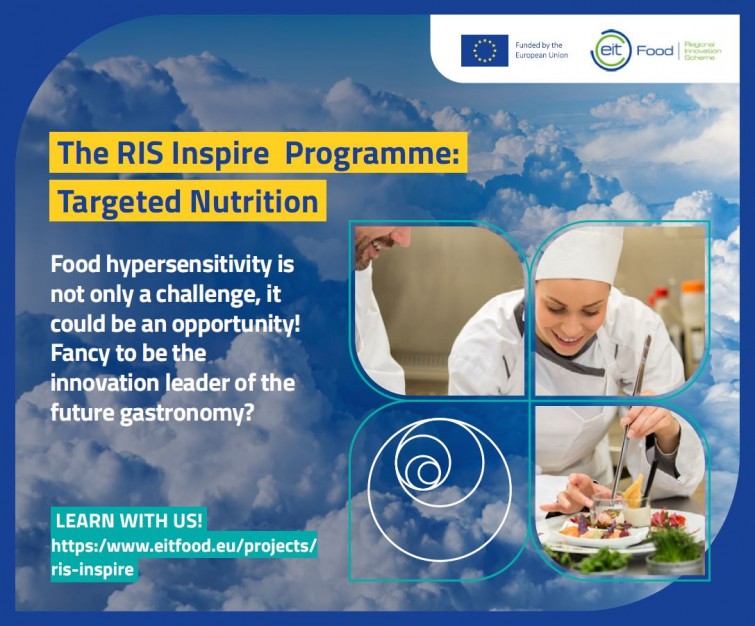
Would you like to become one of the innovation leaders of the future gastronomy sector?

Join the group of ambitious and creative young people, who supported by researchers, industry experts, and professional chefs will co-create new concepts and products addressing the needs of allergic and hypersensitive consumers. In our school, you will get state-of-the-art knowledge and skills around management of food safety hazards and the development of targeted nutrition solutions. You can rebuild the trust of consumers in food services, just believe that food hypersensitivity is not only a challenge but also an opportunity!

Apply now to RIS Summer School in Targeted Nutrition powered by EIT Food!

Apply now

The EIT Food RIS Summer School in Targeted Nutrition is organized by Institute of Animal Reproduction and Food Research PAS (Poland) together with Arhus University (Denmark), Matis (Iceland), IMDEA Food (Spain), Bologna University (Italy), BCC Innovation Culinary Center (Spain) and University of Cambridge (England).
 

OVERVIEW

The RIS Summer School will be available fully online from September 3rd until October 1st, 2021. Most of the time, students will work flexibly at the times of their convenience. They will also participate in live-hosted online exercises. Learning will include lectures on the state-of-the-art knowledge on food allergy, entrepreneurship modules, quizzes, message boards and problem-solving exercises.

The program has 4 main phases: introductory phase, early phase, middle phase and final phase.

Introductory phase (September 3rd) students will define their competence profiles to facilitate further division into subgroups

Start-up phase (September 6th-10th) includes entrepreneurship modules and a number of lectures on the different aspects of food allergy and allergens delivered as asynchronous blocks. In addition, quizzes dedicated to food allergens will be included as well as some live online activities. A detailed timetable will be available on the Canvas platform.

Middle phase (September 13th-17th): the content of this phase is mainly focused on entrepreneurship. During this week students will have an online discussion dedicated to ideating and prototyping, intellectual property rights , trademarks and copyright. One of the live online activities will be performed to provide students with information and instructions on effective pitching and communication. Additionally, students will have the opportunity to hear the success story of Rising Food Stars.

End phase (27th September-1st October): last week of the Summer School contains three blocks of the entrepreneurship and two food-related lectures on nutritional programming and microbiological aspects of food allergy. Students will participate online in a live culinary adventure with professional chefs. October 1st is the date of the Final Pitch in front of a professional jury, followed by teams graduation and winners awarding.

EVERYTHING YOU NEED TO KNOW

Who can apply:

The course is open to Bachelor, MSc and PhD students as well as graduates and professionals interested in nutrition and food. The course would also suit aspiring entrepreneurs or professionals wishing to move into this sector. There is no precondition concerning your study background.

Territory requirements:

Applications are accepted from the following territories (based on citizenship):
Albania, Armenia, Bosnia and Herzegovina, Bulgaria, Croatia, Cyprus, Czech Republic, Estonia, Faroe Islands, Georgia, Greece, Hungary, Italy, Latvia, Lithuania, Malta, Moldova, Montenegro, North Macedonia, Poland, Portugal, Romania, Serbia, Slovakia, Slovenia, Spain, Turkey, Ukraine.

Language requirements:

English

CAREER OPPORTUNITIES

RIS Summer School in Targeted Nutrition aims to educate young academics and ignite their entrepreneurial talents. The School will mentor a new generation of European food innovators, through an entrepreneurial approach linked to food allergies. Students will be provided with state-of-the-art knowledge and skills around the management of food safety hazards and the development of targeted nutrition solutions.

Read more

Recruitment 2021

Recruitment website

Based on the Article 200 of the Act of July 20th, 2018 Law on Higher Education and Science (Journal of Laws of 2018, item 1668 as amended) and on the basis of Article 291 of the Act of July 3rd, 2018. The provisions introducing the Act – Law on Higher Education and Science (Journal of Laws of 2018, item 1669, as amended) and the Agreement of March 16th, 2020 on the establishment of a doctoral school called „Interdisciplinary Doctoral School of Agricultural Sciences” and the Rules of Recruitment to the Interdisciplinary Doctoral School of Agricultural Sciences signed between the parties: Institute of Animal Reproduction and Food Research of the Polish Academy of Sciences (IAR&FR PAS) in Olsztyn, National Veterinary Research Institute (NVRI) in Puławy and Institute of Agrophysics of the Polish Academy of Sciences (IA PAN) in Lublin.

The Director of the Interdisciplinary Doctoral School announces:

recruitment to the Interdisciplinary Doctoral School of Agricultural Sciences in the following scientific disciplines:

  • animal science and fisheries,
  • nutrition and food technology,
  • veterinary science,
  • agriculture and horticulture,

in accordance with the following limits:

IAR&FR PAS Olsztyn animal science and fisheries

nutrition and food technology

12 PhD students
NVRI in Puławy veterinary science 1 PhD student
IA PAN Lublin agriculture and horticulture 2 PhD students

The recruitment will be conducted to specific research projects announced on the Institutes’ websites:

IAR&FR PAS Olsztyn

Discipline: animal science and fisheries:

  1. Importance of fatty acids and their transporters for placenta development in the pig.
    Supervisor: Agnieszka Blitek, Prof., D.Sci.
    download PDF
  2. The secretory function and proliferation activity of endometrium: involvement of phoenixin 14.
    Supervisor: Magdalena K. Kowalik, Ph.D., D.Sc.
    download PDF
  3. Hydrogel-based model of membrane potential generation and its implications for early embryogenesis.
    Project PI: Magdalena Kowacz, Ph.D.
    download PDF
  4. Voltage across a hydrogel: A new perspective on cell’s membrane potential.
    Project PI: Magdalena Kowacz, Ph.D.
    download PDF
  5. Maternal obesity and epigenetic and metabolic regulations during gametogenesis and early embryo development in mice: the specific role of leptin signalling.
    Supervisor: dr hab. Antonio Galvao
    download PDF
  6. The understanding molecular mechanism of interactions between macrophages and endometrial fibroblasts in processes related to pathogenesis of endometrosis in mares – (OPUS 19; NSC).
    Project PI: dr Anna Szóstek-Mioduchowska
    download PDF
  7. Maternal effect on progeny quality in Eurasian perch (Perca fluviatilis).
    Project PI: dr Daniel Żarski
    download PDF
  8. Paternal effect on progeny quality in Eurasian perch (Perca fluviatilis).
    Project PI: dr Daniel Żarski
    download PDF

Discipline : nutrition and food technology

  1. Ultra-sensitive tools for detection antibiotics as a new strategy to control treatment and withdrawal period after cattle antibiotic therapy.
    Project PI: dr Katarzyna Kurzątkowska
    download PDF

NVRI in Puławy

Discipline: veterinary science

  1. Ocena sytuacji epidemiologicznej w zakresie występowania u świń chorób wywoływanych przez Mycoplasma spp.
    Promotor: dr hab. Jacek Żmudzki, profesor instytutu

IA PAN Lublin

Discipline: agriculture and horticulture

  1. Changes of O-acetylation degree of non-cellulosic polysaccharides during fruit development and ripening and its influence on mechanical properties and microstructure of plant tissue.
    Supervisor: Monika Szymańska-Chargot PhD DSc
  2. Use of waste from Hermetia illucens rearing as biofertilizers.
    Supervisor: prof. dr hab. Andrzej Bieganowski
  3. The role of the metabolic, morphological and genetic properties of Neosartorya spp. fungi in shaping their resistance to preservatives, chemicals and natural plant extracts.
    Supervisor: prof. dr hab. Magdalena Frąc

In accordance with the Act 2.0 of the Ministry of Science and Higher Education, each doctoral student receives a scholarship of no less than PLN 2371.70 (gross).

Documents:

List of documents required for the selection procedure (download PDF)

Call for applications and method of submission:

IAR&FR PAS Olsztyn

Traditional mail – to the following address:

Interdisciplinary Doctoral School of Agricultural Sciences,
Institute of Animal Reproduction and Food Research of the Polish Academy of Sciences,
10 Tuwima Street, 10-748 Olsztyn,
by September 7th, 2021 by 15.00 CET.

By e-mail – to the following address: a.andronowska@pan.olsztyn.pl,
by September 7th, 2021 by 15.00 CET.

NVRI in Puławy

Traditional mail – to the following address:

Interdisciplinary Doctoral School of Agricultural Sciences,
National Veterinary Research Institute (NVRI) in Puławy
Partyzantów Avenue 57, 24-100 Puławy,
by September 7th, 2021 by 15.00 CET.

By e-mail – to the e-mail address: ppolak@piwet.pulawy.pl
by September 7th, 2021 by 15.00 CET.

IA PAN in Lublin

Traditional mail – to the following address:

Interdisciplinary Doctoral School of Agricultural Sciences,
Bohdan Dobrzański Institute of Agrophysics of the Polish Academy of Sciences,
4 Doświadczalna Street, 20-290 Lublin,
by September 7th, 2021 by 15.00 CET.

By e-mail – to the e-mail address: sekretariat@ipan.lublin.pl
by September 7th, 2021 by 15.00 CET.

Schedule:

  1. Verification of applications in formal terms: September 9th, 2021;
  2. Interviews (possible changes of the deadline will be placed on the School’s website): September 13th-22rd, 2021;
  3. Publication of a detailed schedule of interviews, including information about the time of the examination of the candidate concerned: September 10th, 2021 by 12:00 CET;
  4. Publication of ranking lists: September 27th, 2021 by 16:00 CET.

Documents to download:

  1. Recruitment Rules
  2. Annex 1 – Required Documents
  3. Annex 2 – Application Form Template
  4. Annex 3 – Consent to the processing of personal data
  5. Annex 8 – List of certificates

Read more

Programme of the Vth Sympozium

The first day – 26th May

Time (CET) Prezenting author Title of prezentation
10.00 – 10.10 Anna Korzekwa
Marek Konarzewski
Invitation
10.10 – 10.20 Anna Kononiuk Presentation of Department of Biodiversity Protection IAR&FR PAS
SESION I – Chairman – Prof. Marek Konarzewski
10.20 – 10.55 Daniel Żarski Fish domestication and its effect on shaping biodiversity of aquatic ecosystems
10.55 – 11.30 Agnieszka Sergiel Chemical communication in brown bears
11.30 – 12.05 Jumpei Tomijasu The oily secretion of back skin in male brown bears: Involvement with apocrine gland cells
12.05 – 12.30 BREAK
12.30 – 13.00 Dorota Okoń,
Anna Hodorowicz
Działalność Zespołu Parków Krajobrazowych Województwa Śląskiego na rzecz zachowania różnorodności biologicznej
13.00 – 13.30 Angelika Nieszała Factors affecting forest damage dynamics by European bison (Bison bonasus) in Bieszczady Mountains
13.30 – 14.00 Karol Puchała Assessing the genetic diversity of a wild population of the peregrine falcon Falco peregrinus peregrinus

The second day – 27th May

Time (CET) Prezenting author Title of prezentation
SESION II – Chairman – Prof. Anna Korzekwa
10.00 – 10.35 Małgorzata Kotula-Balak The bank vole – model for the study of the reproductive system physiology
10.35 – 11.10 Taisiia Yurchuk Egg yolk-free cryopreservation of canine spermatozoa
11.10 – 11.30 BREAK
11.30 – 12.05 Elena Buzan Exploring the relationship between neutral and adaptive variation, spatial behaviour and fitness parameters in European roe deer
12.05 – 12.35 Anna Korzekwa Artificial reproductive techniques (ART) applied in female of Cervids adapted from domestic ruminants
12.35 – 13.00 Kamil Oleński Towards a panel of SNP markers useful for evaluating the genetic variability and relationship analysis in roe deer (Capreolus capreolus)
13.00 – 13.20 Angelika Kotlarczyk Copeptin as a stress marker in blood plasma of the roe deer (Capreolus capreolus L.) living in the forest and field biotope
13.20 – 13.55 Zygmunt Giżejewski Antlers of deer as an bioindicator of environmental pollutions
13.55 – 14.30 Felicita Urzi Genetic structure of wildcat (Felis silvestris) populations in the area between the dinaric and scardo-pindic mountains
14.30 – 14.45 Anna Korzekwa Summary of sympozjum


Read more

Organizers

Department of Biodiversity Protection (IAR&FR PAS)

Prof. Anna Korzekwa, Ph.D. – Chairman

Anna D. Kononiuk, Ph.D.

Jumpei Tomiyasu, DVM, Ph.D.

Read more

Important information

The online symposium will be held on the ZOOM platform, and participation in the symposium is free of charge.

Due to the participation of people from other abroad countries, the language of abstracts and presentation is English.

Deadline of registration and abstract submission – 4th of May, 2021.

Notification of Acceptance – 6th of May, 2021.

Read more

5th Symposium: Perspectives in biodiversity protection

We invite you to participate in the next, fifth edition of the Symposium „Perspectives in the protection of biodiversity”.

The symposium will be held on May 26-27, 2021 ON-LINE (ZOOM platform).

We plan lectures by invited scientists from Europe and presentations selected from among the submitted abstracts. Among the invited speakers will be Prof. Elena Buzan, Prof. Georgi Markov and dr hab. Małgorzata Kotula-Balak, prof. extra.

Please send abstracts via the Application Form.

Participation in the Symposium is free of charge.

On behalf of the Organizers,
Prof. Anna Korzekwa

Read more