Polish Journal of Food and Nutrition Sciences with a state grant

The scientific quarterly Polish Journal of Food and Nutrition Sciences has received funds from the Ministry of Education and Science Republic of Poland as a part of the program “Development of scientific journals” (project no. RCN/SP/0520/2021/1). The program aims at improving the level of publishing and editing practices, increasing the impact of scientific journals on science development, and extending the international range of scientific journals.

The financing is planned for 2022-2024 and amounts to 120,000 PLN.

Read more

Koniki polskie

Scientific and practical aspects of horse reproduction – conference

On February 23-25, 2023, the Walewice Horse Stud will host the 1st Conference entitled „Scientific and practical aspects of equine reproduction.” The Committee of Veterinary Sciences and Reproductive Biology of the Polish Academy of Sciences and the Polish Hippiatric Society have assumed scientific patronage of the event. One of the organizers of the conference is our Institute.

The conference’s main objective will be to exchange scientific and practical experience and integrate the community of researchers and practitioners: zootechnicians and veterinarians dealing with equine reproduction in Poland. The conference will be divided into two parts: scientific and practical.

The scientific discussion will focus on the genetic basis of equine reproduction, biotechniques and biotechnology of equine reproduction, and the physiology and pathology of these animals. Oral presentations and poster sessions are planned. The practical workshop is divided into theoretical and practical parts. Workshop participants will learn about various aspects of stallion reproduction with particular emphasis on issues related to semen collection and preparation for insemination.

The conference is organized by the Department of Team of Reproductive Pathology and Translational Medicine of the Institute of Animal Reproduction and Food Research of the Polish Academy of Sciences in Olsztyn; the Department of Animal Reproduction, Anatomy and Genomics of the Agricultural University in Cracow; the Department of Reproduction with the Clinic of Farm Animals of the Faculty of Veterinary Medicine of the Wrocław University of Life Sciences; and the Center for Equine Reproduction in Walewice.

More information on the Conference can be found on the website.


Read more

Dr hab. Agnieszka Wacławik

Prof. Agnieszka Wacławik recipient of the SRF Academic Scholarship

Prof. Agnieszka Wacławik from our Institute has been awarded the prestigious SRF Academic Scholarship by one of the world’s oldest scientific societies specializing in human and animal reproductive biology.

The Society for Reproduction and Fertility (SRF) has awarded prof. Agnieszka Wacławik from the Department of Mechanisms of Hormone Action, the SRF Academic Scholarship for Reproduction and Fertility. Prof. Wacławik received a grant to continue her research program on „Novel role for estradiol-17β in embryo-maternal crosstalk”.

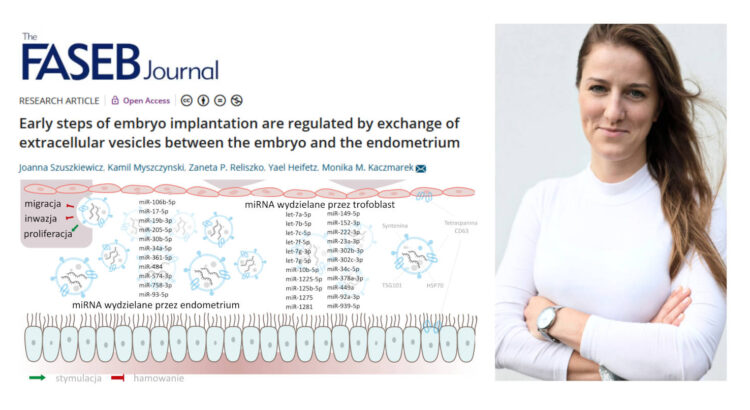
The project’s goal will be to study the role of estradiol, an embryonic signal in the pig, in regulating the function of the cells from which the placenta develops – the embryonic trophoblast and endometrial cells. New signaling pathways involved in embryo implantation and placental development will be investigated.

The Society for Reproduction and Fertility is one of the oldest international scientific societies related to human and animal reproductive biology, dating back to the 1940s. The SRF organizes annual conferences and publishes the journals Reproduction and Reproduction & Fertility, among others.

For more information, visit the SRF website.


Read more

Metody przechowywania nasienia

Innovative buffers will extend the shelf life of fish semen

Existing methods of storing fish semen are not perfect. Researchers at our institute, Dr. Radosław Kowalski and Agnieszka Brzyszcz, MSc., have developed special diluents that will significantly improve the process while protecting the sperm.

Climate change has led to the desynchronization of male and female spawning. It is now common for males to mature much earlier than females, hence the need for methods of storing the semen used for fertilization. Under the direction of Radosław Kowalski, Ph.D., researchers from our Institute have created special buffers for carp and trout that can improve this process. The project „Method of storing fish semen under production conditions” was carried out under the Innovation Incubator 4.0 program.

We asked Dr. Radoslaw Kowalski about the significance of his research and what it could change among fish farmers.

How is fish semen currently stored?

Dr. Radosław Kowalski: In hatchery practice, semen taken directly from the fish is stored in a container or bag with oxygen – such methods work well within hours of collection. Keeping undiluted semen risks declining quality immediately, as urine contamination is dangerous. Fish semen has the property that it is activated by low osmotic pressure so that it can be accidentally activated by urine. Long-term storage of semen with oxygen is also not good – our studies have shown that oxidative changes bring more harm than benefit.

What can be done to improve existing methods?

RK: We have developed special immobilizing liquids for storage. If, during sperm retrieval, it becomes contaminated with urine, sperm movement will not be activated after dilution in the immobilizing fluid. In the favorable environment created by the buffer, sperm „recharge their batteries,” that is, rebuild their energy reserve in the form of ATP, which positively affects their motility. Thanks to diluents, we can regenerate any sperm – from 0 to even 90% of mobile sperm.

Does such a method also work in the long run?

RK: When we store sperm in a buffer for a long time, about 5 percent of the resulting offspring develop into embryos with severe deformities, such as heart defects or other physiological changes… It turned out that sperm stored for a long time had oxidative changes in DNA (at the level of the epigenome) that caused permanent genetic changes. Old sperm can be responsible for lower-quality offspring, as we see throughout the natural world.

Can this cellular aging be stopped?

RK: As part of the Innovation Incubator 4.0 project, we used antioxidant additives to protect sperm from oxidative changes within the genetic material. We used three different antioxidants and observed how they worked – vitamin E was the best. We studied two species of the most popular fish in Poland – carp and rainbow trout. These are two extreme examples – trout is a cold-loving fish, and carp is warm-loving. Trout have spermatozoa resistant to oxidative changes in the genome due to the presence of protamines as chromatin-stabilizing proteins. Carp spermatozoa are more sensitive to these changes because their genome is stabilized by histones, which are less efficient at packing DNA.

Our study compared the differences in sperm quality and motility after a designated storage period – in trout for a month and carp two weeks after harvesting. We also analyzed the quality of offspring obtained from fertilization using semen stored in this way. In both cases, we used mixtures of antioxidants, and vitamin E performed best.

What else is in the buffers?

RK: The composition of the buffers was patented back in 2014. I can’t reveal the concentrations of antioxidants, but the basic composition of the buffers itself is public. The most critical substances are sodium and potassium. There is also magnesium, calcium, and a pH stabilizer. In addition, we were the first in the world to enrich the composition of buffers with thickening polysaccharides (alginates, carrageenans, and xanthans), which prevents gravitational sedimentation of sperm and their consequent sinking to the bottom of the containers. Sedimentation is a process by which, after just 48 hours, more than 90% of sperm can be permanently damaged.

Can the composition of buffers be further improved?

RK: Antioxidants of natural origin change their color under different pH. My research goal is to create additives that indicate changes in pH by color. I want to develop a buffer that, on the one hand, would protect sperm and, on the other hand, through its color, would show how advanced the aging changes of sperm are. Such a solution would make life much easier for fish breeders, who could tell from the color changes whether or not to use a given sperm.


Read more

Biotechnika i Biotechnologia Rozrodu

Research on cryopreservation of fish semen of our scientists with award from PAS Division II

Scientists from our Institute have received an award from Division II of Biological and Agricultural Sciences of the Polish Academy of Sciences. Their contribution to developing and improving protocols for the cryopreservation of salmonid and perch fish semen was awarded.

On November 24, 2022, during the plenary meeting of Division II of Biological and Agricultural Sciences of the Polish Academy of Sciences, it was decided to award the honor to the scientific team from the Institute of Animal Reproduction and Food Research of the Polish Academy of Sciences, consisting of:

  • Prof. Andrzej Ciereszko;
  • Sylwia Judycka, Ph.D.;
  • Joanna Nynca, Ph.D.;
  • Mariola Dietrich, PhD.

The award was given to a series of works on the research issue about: „Development of a standardized method for cryopreservation of fish semen and its implementation in salmonid breeding improvement programs”.

Importance of the research work

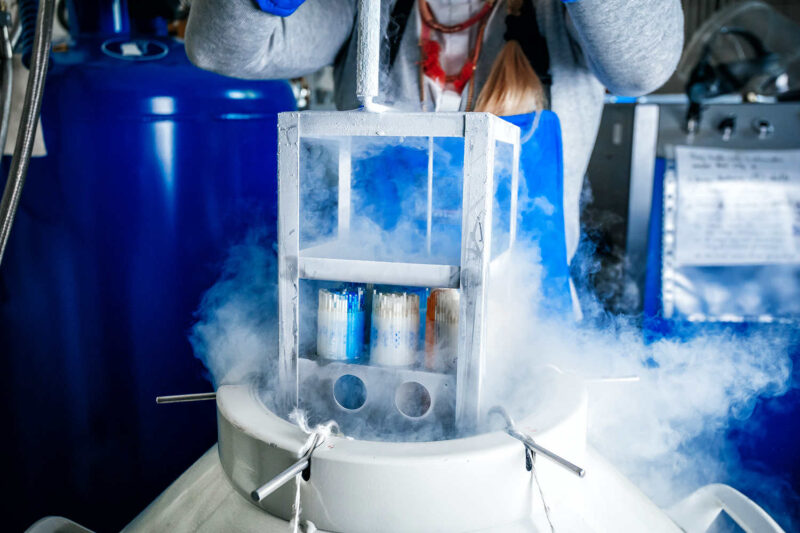
Cryopreservation is the process of storing biological material (cells, tissues, embryos) at low temperatures (-196 ºC). Under such conditions, all biological activity stops. Theoretically, the viability of natural material stored in liquid nitrogen should be maintained for at least 3000 years. Cryopreserved semen is widely used in cattle breeding and assisting human reproduction, but the practice has not been introduced to fish breeding.

This study focused on developing a procedure for cryopreserving semen from salmonids (rainbow trout, alpine pilchards, grayling, rainbow trout, and brook trout) and perch (perch and zander), which can be used to create semen banks. Researchers from our Institute focused on learning about the changes in fish sperm that occur during cryopreservation. The study also showed that the following factors significantly affect the success of cryopreservation: the final concentration of sperm, the final concentrations of glucose and methanol in the diluent, and the time of equilibration of semen in the diluent before cryopreservation. The developed standardized semen cryopreservation procedure, once implemented in hatchery practice, should significantly improve selection work in fish farming.

At the plenary meeting of Division II of Biological and Agricultural Sciences of the Polish Academy of Sciences, a total of one award and four honorable mentions were given to scientific teams from institutes of the Polish Academy of Sciences and other units. The complete list of awardees can be found here.


Read more

Sylwia Judycka

Dr. Sylwia Judycka awarded the L’Oréal-UNESCO For Women and Science scholarship

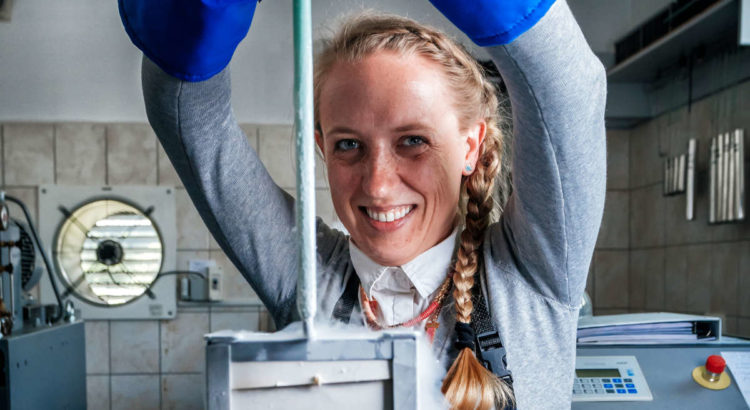
Dr. Sylwia Judycka, from the Department of Gamete and Embryo Biology of the Institute of Animal Reproduction and Food Research of the Polish Academy of Sciences, has been awarded a scholarship in the 22nd edition of the prestigious „L’Oréal-UNESCO For Women and Science” program.

Each year, the „L’Oréal-UNESCO For Women and Science” program awards 6 outstanding Polish female researchers for their exceptional contributions to science and their passion and commitment to their work.

Dr. Sylwia Judycka was recognized for her research on developing and optimizing procedures for the cryopreservation of fish semen. The jury appreciated the level of her scientific achievements, the originality of her research, her innovative approach, and her ability to apply the results of her research in practice.

Dr. Judycka’s research concerns effective methods of preserving the biodiversity of native fish species, which is extremely important today in the face of climate catastrophes. In her research, she uses the cryopreservation technique, which involves storing fish semen at low temperatures, but ensuring that sperm remain viable after thawing. She and her team have demonstrated the effectiveness of this technique for salmonid and perch species. The point of the developed procedures has been confirmed by the high results of egg fertilization using cryopreserved semen.

I dream that the results of my research will be put into practice in the future and help fish reproduction. I am pleased that our standardized methodology for cryopreservation of rainbow trout semen has proved successful so that semen banks can be established, providing an unlimited amount of semen to support fish reproduction. This is important in increasing water pollution, habitat destruction, overfishing, and climate change. My research will help protect the gene pool of natural fish populations and preserve native species – Dr. Sylwia Judycka says about her research.

The goal of the L’Oréal-UNESCO Program for Women and Science, conducted since 2001, is to promote the scientific achievements of talented female researchers, encourage them to continue their work aimed at advancing science, and provide financial support. Partners of the program are the Polish Committee for UNESCO, the Ministry of Education and Science, the Polish Academy of Sciences, and UNGC Network Poland.

The decision to award the scholarships is made annually by an independent Jury of 18 prominent scientists. Each of the jurors represents a different scientific field and research center across Poland. The jury is chaired by Prof. Ewa Łojkowska.

By 2022, 117 female scientists will have been awarded in Poland.

Dr. Judycka is the second finalist in the L’Oréal-UNESCO For Women and Science program at our Institute. In 2017, this honor went to Anna Michalska-Ciechanowska.

More information about the competition is here.


Read more

AQUAENT workshop

AQUAENT – aquaculture in the age of global challenges – workshop report

On November 17, 2022, we held an online workshop „AQUAENT – aquaculture in the era of global challenges” as part of the EIT Food AQUAENT project – Support for small and medium enterprises in RIS regions in aquaculture. The topics of the workshop covered most burning topics from the pollution of the genetic environment and biotechnological methods of protecting wild-living fish gene pools, through multitrophic aquaculture, to the use of renewable and geothermal energy. We also had a chance to learn the outcomes of the innovative Salmocross project and its possible implementation in aquaculture.

Check out the lectures:

  1. Renewable energy and the potential of energy storage in aquaculture – futurology or activities necessary for the survival of the industry in times of energy crisis? Ziemowit Pirtań, The fishing farm „PSTRĄG TARNOWO”, Tarnowo, Poland;
  2. Salmocross – an innovative research and implementation project in aquaculture. Martyna Sas The fishing farm „PSTRĄG TARNOWO”, Tarnowo, Poland;
  3. Multitrophic aquaculture – possibilities of intensifying production in fresh and salt waters. Radosław Kowalski, Institute of Animal Reproduction and Food Research of the Polish Academy of Sciences, Olsztyn, Poland;
  4. Genetic pollution of the environment and biotechnological methods of protecting gene pools of wild-living fish. Konrad Ocalewicz, University of Gdańsk, Gdańsk, Poland;
  5. The use of enzymes and proteins in fish waste to create innovative medical products and dietary supplements. Margret Geirsdottir, Lysi-Life, Zymtech Enzymatica Aktieägare, Icelandic Food and Biotech R&D, Reykjavík, Iceland;
  6. The use of geothermal energy in fisheries and aquaculture. Saemundur Eliasson, HS Orka and Haustak, Icelandic Food and Biotech R&D, Reykjavík, Iceland.


Read more