Research into processes occurring in skin cells has yielded new and surprising insights into their role in tissue regeneration. It turns out that mechanisms previously associated mainly with ageing may also play an important role in wound healing and much more rapidly than previously thought.
Dr Sylwia Machcińska-Zielińska from our Institute’s Regenerative Biology Team participated in an international research project led by Dr Mikołaj Ogrodnik’s group at the Ludwig Boltzmann Institute for Traumatology, the Research Center in Cooperation with AUVA in Vienna. Dr Machcińska-Zielińska’s postdoctoral fellowship was funded under the ERA Chair – WELCOME2 project.
The research findings were published in the prestigious journal Nature Cell Biology in the article entitled “Transcription-independent induction of rapid-onset senescence is integral to healing.” The study focuses on cellular senescence a distinct state in which a cell stops dividing but remains active and continues to send signals to other cells. Until now, senescence has been associated primarily with organismal ageing and disease development. However, the research team led by Dr Ogrodnik has shown that, under certain conditions, it can also fulfil an important and beneficial function.
The researchers demonstrated that skin cells located at the edge of a wound can enter a senescent state within minutes or a few hours after injury. This is a significant discovery, as it was previously believed that the development of this state required considerably more time.
Moreover, this process does not require the activation of new gene transcription. Instead, cells use pre-existing mRNA molecules that the skin keeps, in a sense, “on standby” in case of injury. This allows the response to occur very rapidly.
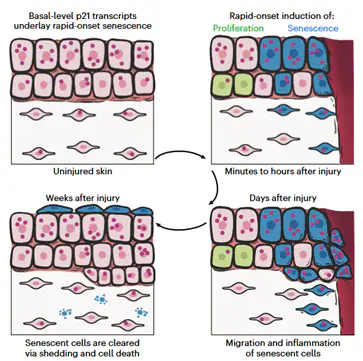
The study also showed that these rapidly generated senescent cells actively contribute to the initial phase of wound healing. They send signals that help neighbouring cells migrate towards the damaged area. Inhibiting this response significantly delayed the healing process.
This is important knowledge for patients and clinicians alike, as a better understanding of the first minutes and hours after injury may, in the future, help develop more effective ways to support wound healing especially in cases where wounds heal poorly or too slowly.
The publication has attracted considerable interest from the scientific community and has also been covered by specialist and popular science outlets, including The Scientist.