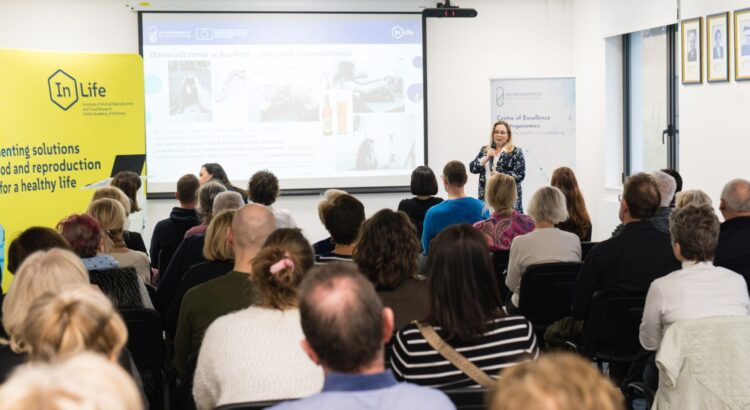
The human body functions in close connection with daily circadian and seasonal rhythms. Health and well-being are influenced by many biological and environmental factors, such as exposure to sunlight, sleep, physical activity, diet, and the gut microbiome. How natural cycles shape the functioning of the human body was the focus of the educational meeting „In the Rhythm of the Sun and the Seasons. Cycles That Govern Our Body”.
This was the fifth meeting organized as part of the ERA Chairs WELCOME2 project. The event took place on Saturday, December 13, at the InLife Institute and gathered more than 60 participants. The speakers included researchers from the InLife Institute of Animal Reproduction and Food Research of the Polish Academy of Sciences, as well as a guest expert from the University of Warmia and Mazury.
The circadian rhythm as the key to health
At the very beginning of the meeting, dr Aleksandra Szczepkowska from the Physiology and Toxicology Team emphasized that every cell in our body has its own timekeeping mechanism. In a professional yet accessible way, she explained how being influenced by the day–night cycle and changing seasons affects the functioning of the human body, well-being, and energy levels. The lecture clearly showed that disruptions to the circadian rhythm-such as shift work, excessive artificial light, or irregular sleep-have real physiological consequences.
The sunny vitamin – D3
Dr Julia Jarosławska-Miszkiewicz from the Nutrigenomics Team spoke about how vitamin D affects our immunity, well-being, and sleep rhythm. Participants learned how the lack of light in winter influences brain function and the immune system. The researcher emphasized that vitamin D, commonly known as a dietary supplement or medication, is first and foremost a hormone. It acts as a guardian of our immunity, and the most powerful factor influencing its level is sunlight.
The clock and gut function
The next lecture shifted attention to the gut. Dr Anna Ogrodowczyk from the Food Immunology and Microbiology Team explained that the microbiome also “lives by the clock.” The composition and activity of gut bacteria change throughout the day and across seasons, responding to what we eat, when we eat, and how we live. She highlighted the importance of a seasonal diet for the microbiome and discussed the consequences of improper nutrition, which may lead to a reduction in the natural cyclical diversity of the microbiome-an important foundation of our immunity.
The clock and physical activity
An expert from the Collegium Medicum of the University of Warmia and Mazury, dr hab. Michał Boraczyński, professor at UWM, talked about how physical activity influences the regulation of sleep and wakefulness rhythms. Participants learned when to engage in intense exercise and when to choose calmer activities that support recovery. He also discussed chrono-exercise, a new field of research that takes into account the timing of physical activity.
– Knowledge builds resistance to disinformation and manipulation, which is why during educational meetings we offer a high-quality dose of reliable information. Direct contact with scientists helps build trust in credible scientific sources – emphasized Iwona Kieda, the event coordinator.
During breaks, participants were able to take part in a tasting of fermented foods. Healthy products were provided by Łukasz Świątkowski from a family-owned company in Kisiny, which has specialized in the natural production of fermented foods for many years.
Thank you for your participation, engagement, and interest. See you at the next educational meetings!