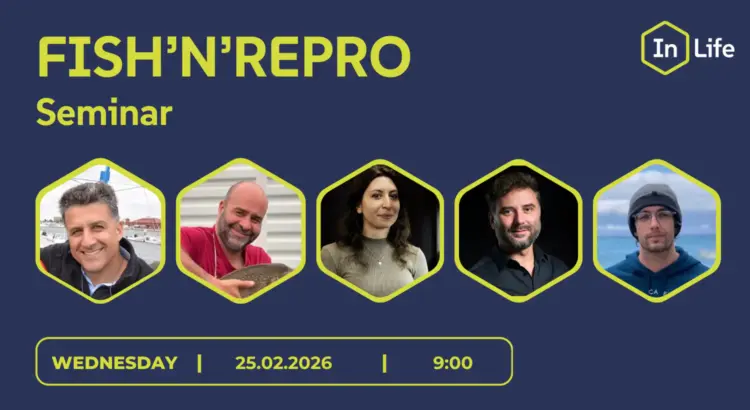
Can dominance in fish reproduction be controlled? How can egg quality be improved through the identification of molecular markers? In what ways do circadian rhythms influence organismal development, and how does gene expression dysregulation affect larval condition? These are just some of the key questions that will be addressed during the open Fish’n’Repro seminar, organized on 25 February 2026 by the InLife Institute of Animal Reproduction and Food Research, Polish Academy of Sciences.
The aim of the event is to facilitate the exchange of expertise, present current research findings, and identify common research areas that may serve as a foundation for further international scientific collaboration. The seminar is addressed to researchers working in the field of reproductive biology as well as professionals involved in fish farming and aquaculture.
Special Guests from the Hellenic Centre for Marine Research
The event will feature lectures by researchers from the Hellenic Centre for Marine Research (HCMR), one of Europe’s leading institutions in aquaculture research.
Prof. Constantinos (Dinos) C. Mylonas – Director of the Institute of Marine Biology, Biotechnology and Aquaculture (IMBBC) and a recognized expert in fish reproductive physiology and endocrinology. His research focuses on identifying reproductive dysfunctions in captive fish and developing environmental and pharmacological methods to control maturation and spawning.
Dr Ioannis (Yannis) Fakriadis – Research scientist specializing in fish reproductive physiology and practical approaches to controlling reproductive processes in aquaculture. His interests include selective breeding, assisted reproduction, gamete quality assessment, and reproductive behaviour analysis.
Programme:
Constantinos (Dinos) C. Mylonas, Professor (HCMR)
Fish Reproduction in Mediterranean Aquaculture and its Control
Ioannis (Yannis) Fakriadis, PhD (HCMR)
Dominance in fish reproduction: can we manipulate it?
Daniel Żarski, PhD (InLife)
Fishing for molecular indicators of egg quality in pikeperch
Oliver Barić, PhD Student (InLife)
Winding the clock: current knowledge on circadian rhythm development in Eurasian perch
Rossella Debernardis, PhD Student (InLife)
Heart oedema in Eurasian perch larvae is associated with multi-tissue gene dysregulation
Fish’n’Repro has an interdisciplinary character, combining fundamental research with its potential applications in fish farming. The meeting will provide a platform for in-depth discussion, partnership building, and the initiation of joint research projects in the field of reproductive biology and aquaculture.
📍 Venue: InLife Institute of Animal Reproduction and Food Research, Polish Academy of Sciences, Skanda Hall
📅 Date: 25 February 2026
🕘 Time: 9:00 AM
We warmly invite researchers and aquaculture professionals interested in the latest advances in fish reproductive biology to participate.